Back to Work
By Mirandah Davis-Powell for Eugene Weekly
Elizabeth Carroll won a major sexual harassment and discrimination case against Franz Bakery. Seven months later, she says, little has changed.
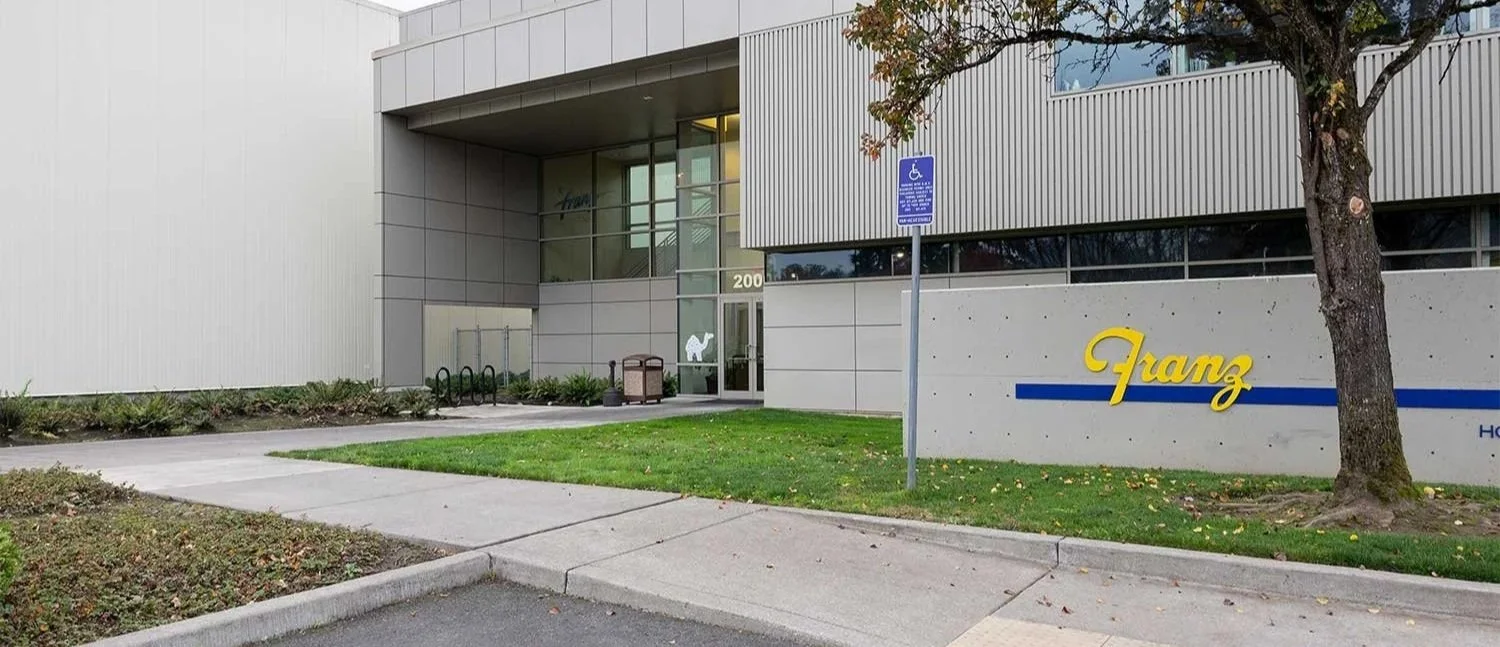
In April, Elizabeth Carroll, 39, arrived at work at Franz Bakery in Springfield, dressed in her company whites with her gloves and hairnet at the ready. She would clock in for her shift in the bun wrap area of the bakery’s production floor, where she packages Franz’s hamburger and hot dog buns in plastic bags, each printed with the company’s signature blue logo. It was routine — as if it were any other day of the 16 years she’s worked there.
It had been two weeks since she’d been to work. Instead, she had been in a Lane County courtroom as a jury heard a sexual harassment and discrimination case Carroll filed against Franz more than a year earlier.
The jury heard evidence that her supervisor at Franz routinely made sexual advances, that he subjected her to retaliation when she refused those advances and that Franz management ignored her complaints.
Franz argued that Carroll only complained when facing discipline and that the bun wrap’s tight quarters made physical contact unavoidable. They argued that her seniority would have enabled her to change positions at the bakery, but she chose to stay. The defense dismissed supporting testimony as “gossip.”
But three former co-workers testified about nearly identical experiences with the same supervisor — unwanted touching, inappropriate comments and personal communication outside of work. One woman said she filed six harassment complaints in her first two years with no follow-up.
On April 18, the jury sided with Carroll and ordered Franz and her supervisor to pay a combined $345,000 in damages.
Three days later, she returned to work in her role as a production worker, uncertain whether she would be treated the same. Many co-workers welcomed her back and celebrated her victory. But seven months later, she says there haven’t been any major changes at the Springfield facility. The same people are in charge, and the company hasn’t acknowledged Carroll’s case.
Franz claims it has a zero-tolerance policy for sexism, racism and harassment that was established in 2006 after four women sued the bakery over sexual harassment and discrimination at the bakery’s Portland facility.
“The people who’ve done stuff are still there,” Carroll tells Eugene Weekly. “So, where is that zero tolerance? That’s the first effective step that they should be taking.”
She says she believes people in management and supervisory positions enabled the harassment she experienced. “I feel like they knew and just let it happen,” she says.
Franz has appealed the verdict. EW has sent a company spokesperson requests for comment six times without a response. The law firm representing Franz and the supervisor, Seattle-based Davis Grimm Payne & Marra, also did not respond to requests for comment.
Brad Currier, a business agent and union representative for Bakery, Confectionery, Tobacco Workers and Grain Millers International Union Local 114, says that Carroll’s victory hasn’t brought any tangible change to the bakery floor.

Illustration by McKenzie Young-Roy
“Unfortunately for us and Liz, when she came back, we had other individuals that were part of that toxic culture that are still kind of feeding that problem,” Currier says. “There’s a lot of that same mentality from the company — they don’t really want to put out an effort to fix it.”
Carroll, originally from Lowell, lives with her wife of eight years and her young son. She’s always worked long-term jobs, working at Ross and an RV company before coming to Franz. She makes $29 an hour during the 8- to 12-hour shifts, and hardly ever gets two days off in a row.
It’s hard work, but she says she stays at Franz for the benefits. She has a pension and great health care, and she’ll retire at 55.
Franz hired her in 2009, starting in croutons, filling and stocking boxes on pallets. On her first day, Carroll tried to listen to the instructions during a walk-through of the bakery, but she couldn’t hear over the loud equipment. She took out her earplugs, and a man yelled at her to put them back in.
That was Jason Bohrer, who would become her supervisor.
Female workers told Carroll early on that Bohrer liked to flirt with women, “hitting on them and being inappropriate with them,” Carroll says.
Before long, Bohrer would come by her work site and touch her shoulder or her back, wink and smile, make her tuck in her shirt extra tight while he watched.
A year or two into her work at Franz, Bohrer began making sexual advances toward Carroll. She recalls that once, Bohrer gestured at her tattoo sleeve on her arm. “I like your tattoos,” he said. “Do you have any more?”
Carroll told him yes, but they were under her shirt. “I can’t share that,” she remembers telling him.
“You could go back there and nobody would see,” she says he told her, referring to a lineup of tall stacks of baskets to hold croutons. “I’ll stand back there with you,” she remembers Bohrer saying. “You can lift up your shirt and show me.”
Carroll says she rejected him, and he walked away. She felt deeply awkward in the moment and shocked that anyone would say that at work, let alone her supervisor. She hoped that after the rejection, he would leave her alone.
“I think it bothered him,” Carroll says, “that I wasn’t willing to flirt with him even though he was in power.”
After that, she says, Bohrer entered a cycle of behavior toward her. “He would try and start with me, and then get mad, and then act really nicely toward me again.”
Carroll made no secret that she was in a same-sex marriage. Her lawsuit alleges that in January 2023, Bohrer walked down a stairway with her from his office. “I think you and I would have a good time, but you don’t like men,” she says he told her.
She ignored the comment and kept walking. “It was scary and gross for me,” Carroll says. “On one hand, I find him repulsive. On the other hand, I know he’s still in charge of me and can get me in trouble for anything.”
Carroll says she’s faced the threat of retaliation, too. According to the lawsuit, when Bohrer’s advances were repeatedly rejected, Carroll would be called to his office and disciplined without a factual basis. Once, she was reprimanded for calling out sick without a doctor’s note, even though she’d already submitted one to Human Resources.
One day, Bohrer called her to his office to complain about a date. His date reacted badly when he put his hand on her thigh, he said. As he recounted the story, he put his hand on Carroll’s thigh.
Carroll froze. A moment later, he removed his hand.
Carroll says his behavior was badgering throughout 2023. “He just would not leave me alone,” she says. “He just was constant. He wouldn’t stop.”
“It came to a point when I couldn’t avoid it anymore and couldn’t escape this person,” Carroll says. “I had no other choice but to confront it head-on.”
She had been talking to her union reps, asking for advice on what to do. They told her she could file a harassment claim, but she didn’t believe anything would happen if she did.
Still, she worked with the union and corporate HR to arrange meetings to address Bohrer’s behavior toward her. “In my opinion, for not trying to meet with me, several times [the meeting] got cancelled or they couldn’t make it work,” Carroll says. “Finally, my union advised me to get an attorney, and that’s what I did.”
With a wife and son depending on her income, walking away was never an option. “I can’t just give up and quit,” she says.
Currier, who encouraged her to seek legal action, describes the culture of sexual harassment at the bakery as an old issue.
Franz Bakery, formerly United States Bakery, is a family-owned operation established in 1906. Their first bakery was headquartered in Portland, and the operation has since grown along the West Coast. Currier’s dad and grandfather both worked at the Springfield bakery.
“This has been going on clear back to their generation,” Currier says. “That’s just been a tradition of [Franz] not doing anything about a problem, even when brought to their attention by multiple people.”
Carroll filed her lawsuit in February 2024. Franz then claimed Carroll had failed to show she suffered any damages. They offered her $20,000 if Carroll dropped the case. She declined.
During the trial in Lane County Circuit Court, Carroll was nervous. She had never been in a courtroom before, and suddenly, she would be telling her story to a room full of people.
She was worried about the jury’s perception of her during her testimony in court, considering she’s gay. “I prayed and I told the truth, and that’s all I could do,” she says.
“They don’t know your character,” she says. “They don’t know if they should believe you or not.”
Her hardest days, she says, were hearing the defense say things that she feels were lies about her. “That’s where they’re questioning your character. If something happens to you, you don’t want to be told that you made it up.”
Franz raised questions about the credibility of Carroll’s claims. They argue her claim about Bohrer’s suggestion that the two of them would have a good time, if only she liked men, arose only as self-defense when she was in an HR meeting for a separate issue.
They further argued that the only times Carroll reported sexual harassment or inappropriate behavior by co-workers and supervisors came up in moments where she would have been disciplined.
Franz’s attorney argued that Carroll’s seniority would have allowed her to move to a union-bid position elsewhere in the bakery at any point, but she chose to stay in bun wrap’s tight quarters.
Bohrer denied each claim Carroll made regarding harassment or inappropriate behavior in testimony. He admitted to having consensual sexual relationships with two of his subordinate co-workers while he was married. The jury learned Bohrer had been suspended in 2017 for similar behavior, including invading women’s personal space and texting employees inappropriately after hours. Still, Bohrer denies any inappropriate physical contact or remarks toward any women.
The three of Carroll’s former co-workers who came to the stand to testify about Bohrer’s conduct each had their own story to tell.
One woman described the way men behaved in the bakery: “There was moments where a lot of men would come through [bun wrap] and sneak behind you instead of going around… There was a lot of taking advantage of the small area.”
She described how Bohrer would make physical contact with her at work, testifying to being “hit [on the] butt” in one instance while she was going up the stairs.
“Out on the production floor, it was the hand brushing, and the hand on my back,” she says.
Another woman testified that Bohrer only texted about personal things, not about work. She described how he would make advancements when she was “in a rough spot.”
“He would touch, brush his hand on my lower back, put his hand on my shoulder,” she says. “Once in the office, he put his hand on my leg.” She added that she remembers the office door always being closed.
When Carroll’s lawyer asked if she felt like the men had more power at Franz, she agreed. She never went to HR, feeling like her complaint would be ignored.
“I went up to HR for questioning on other things people had put in, and still nothing had ever been done after,” she says. “Just brushed under the rug.”
On Friday, April 18, a jury unanimously found Bohrer liable for aiding and abetting an unlawful employment practice. The jury voted 11-1 that Franz Bakery failed to take appropriate corrective action to prevent Carroll from facing a hostile work environment.
Bohrer has not returned to work since the verdict, according to Currier of the bakery union. It’s unclear if Franz terminated Bohrer, if he resigned or if he remains on leave.
While some labor concerns have been addressed after a strike ended in 2024, Carroll says she hasn’t noticed a shift in the culture that tolerates harassment. Currier worries that what has been addressed isn’t enough.
“We still have some people that are in leadership roles there that don’t belong,” Currier says. “It’s one individual versus a mass of this culture that they have.”
Since the trial, women have asked Carroll to witness their HR complaints, but HR has never called her to discuss them, she says.
Carroll wants accountability and transparency from Franz. The company has never acknowledged what happened or outlined steps to prevent it from happening again, Carroll says. “It’s kind of just like, let’s not talk about this and let’s move on.”
Currier and Carroll agree that Franz needs more women in supervisory roles. Workers tell Carroll that they want supervisors who harass their workers to be removed without fear of retaliation.
When Carroll returned to work, many welcomed her back. Raul Rodriguez, who works on the bread wrap line, has checked in on Carroll consistently since she’s been back, offering his support where he can.
“The women, I felt like they were kind of preyed on by certain people,” Rodriguez, who has been at Franz since 2015, says. “I would never let my daughters work here.”
He commends Carroll for her fight to make things better for women at the company. “Liz opened so many doors in a positive way, but she had to go through the negative to get there,” Rodriguez says.
Several women have approached her and privately thanked her for her efforts in the lawsuit, telling her that she has given them the courage to stand up for themselves. Her hope is that Franz will hear them.
“All I can do,” Carroll says, “is keep fighting for what’s right and keep putting my foot down for what’s right and keep going.”
— This story was developed as part of the Catalyst Journalism Project at the University of Oregon School of Journalism and Communication. Catalyst brings together investigative reporting and solutions journalism to spark action and response to Oregon’s most perplexing issues. To learn more, visit CatalystJournalism.uoregon.edu.